Jekyll2025-06-20T16:02:45+00:00https://new.aviadas.com/feed.xmlaviadas.comPersonal website for Avi Das. Home for my thoughts, projects, and more.Avi DasYour One-Click Pass to the Web’s Past2025-06-20T00:00:00+00:002025-06-20T00:00:00+00:00https://new.aviadas.com/software/tech/archive-redirectAnnouncing Archive Redirect: Your One-Click Pass to the Web’s Past
Broken links blocking your research? Paywalls cutting you off mid-article? Curious about what a site looked like before that major redesign? The web’s history shouldn’t be locked away behind friction and frustration.
Archive Redirect is a Chrome extension that instantly transports you to the Internet Archive’s most recent snapshot of any webpage. No URL copying, no tab juggling, no searching through archive interfaces—just pure, frictionless access to the web’s memory.
The problem solved
Every day, millions of links break. Content disappears behind paywalls. Websites change without warning. Until now, accessing archived versions meant:
Copying URLs manually
Opening the Internet Archive in a new tab
Searching and hoping a snapshot exists
Dealing with slow load times and interface friction
There had to be a better way.
How Archive Redirect works
The magic happens in three clicks:
Navigate to any webpage
Click the Archive Redirect icon in your toolbar
Instantly view the latest archived version
That’s it. One click between you and the internet’s history.
Built for the curious and the blocked
Whether you’re a journalist tracking how a story developed, a researcher accessing disappeared content, or simply someone who refuses to let broken links slow them down, Archive Redirect transforms how you interact with the web’s past.
The internet remembers everything. Now you can access it all.
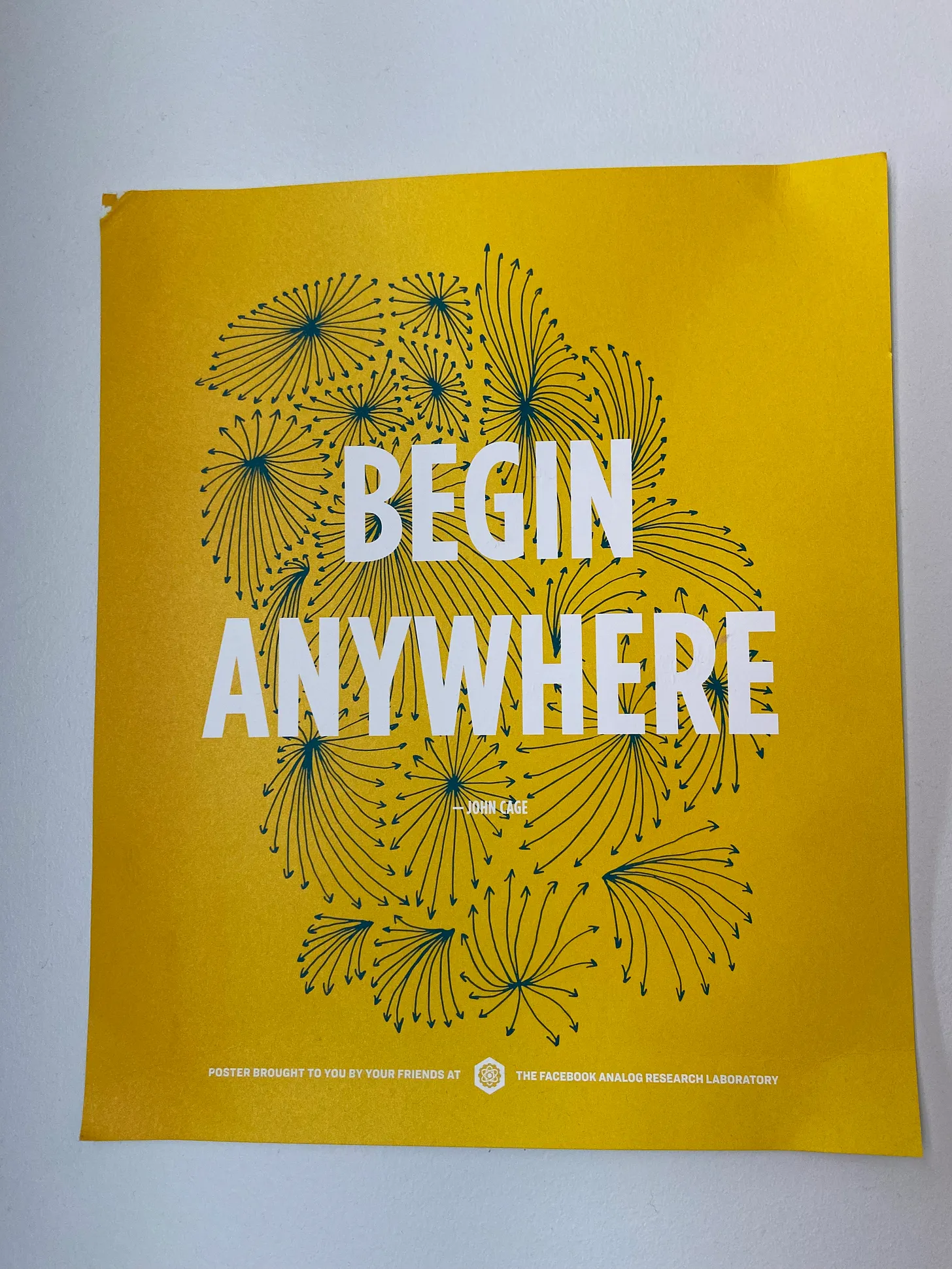
]]>Avi DasBegin Anywhere2025-06-18T00:00:00+00:002025-06-18T00:00:00+00:00https://new.aviadas.com/software/tech/begin-anywhereAt Meta, there’s a group called Analog Research Lab. They materialize the cultural maxims many associate with the company: “Move fast and break things”, “Don’t mistake motion for progress”, “Meta, Metamates, Me” and more.
My favorite has always been “Begin Anywhere”.
The sheer breadth and depth of Meta’s infrastructure, codebase, and business logic make it a significant investment to understand how something works end-to-end. Whether you take a depth-first or breadth-first strategy, you could spend indefinite time exploring.
Despite that complexity, the mindset of starting anywhere is essential.
Engineering at Meta
Almost all the stack is homegrown: languages/runtime, wire protocols, web frameworks, version control, builds, container orchestration etc. Only some (React, GraphQL, PyTorch) are open source.
Unlike companies of similar size, Meta’s entire codebase is open to engineers internally. An engineer working on React could read Erlang code in WhatsApp or firmware code in Reality Labs.
Meta historically encouraged bottom-up innovation over central planning. Your mental model can become outdated in quarters, not years. That’s how fast things change.
Growing in seniority requires increasing leverage. Increasing leverage requires broadening and deepening your knowledge of the ecosystem around your team’s work. The most successful engineers bend reality to their will or convince the organization to bend reality toward their vision.
Applying “Begin Anywhere”
Be strategic about ROI. Is this exploration educational interest, optimistic outreach, or likely to yield near-term results? Clarity here is crucial.
Build minimal viable prototypes. Reading and talking are useful, but nothing makes things concrete like changing code and watching it operate.
Be a beginner publicly. When a very senior engineer on my team was learning Rust, he live-streamed rebuilding a CLI tool. This brought attention from internal Rust experts eager to help.
Stack your learnings. If you understand pieces A and C in a chain A→B→C→D→E, learning B becomes a worthwhile investment.
Embrace partial knowledge. You won’t get full context, but you can build enough mental maps to operate and establish your bases.
The lesson extends beyond Meta: in any complex system, you have to jump into codebases and problems where you lack context. You can figure it out through code, docs, and asking for help. But most importantly:
Begin anywhere. Be comfortable with uncertainty.
]]>Avi DasThe Need to Celebrate Oneself2025-02-12T00:00:00+00:002025-02-12T00:00:00+00:00https://new.aviadas.com/life/the-need-to-celebrate-oneselfThe Milestone
I recently hit 1,000 activities on Strava – 800 from running and the rest biking. My first instinct was to think huh, that’s cool and move on.
But then I stopped myself. This is a significant milestone, telling the story of my discipline and persistence with fitness over the years. Could it have come two years sooner if I’d stayed healthy? Of course. Yet here we are.
So I posted it on Instagram, the home of millennial highlight reels. Five years ago, I might have judged others for similar posts. I noticed the familiar dopamine hit from friends’ likes and messages.
This moment crystallized something that keeps surfacing in therapy and conversations with my wife: I need to do a better job of celebrating myself.
The Marathon Mindset
In my peak years of marathon training, my personality perfectly fit the demands required. I excel when my actions can be distilled toward a singular pursuit. The marathon demanded exactly that – showing up for training runs, eating right, sleeping enough. At times, every waking hour was optimized for that singular goal: chiseling away minutes in pursuit of the three-hour marathon, my ticket to the Olympics of civilian runners – the Boston Marathon.
The process had to be the reward. A good marathon time is anything but guaranteed. You get one, maybe two shots a year. On race day, it could rain or suddenly heat up. One pulled muscle, one stumble, one rolled ankle in those tens of thousands of steps could derail everything. Even perfect training offers no guarantees.
Even after good races, I was already thinking about the next training cycle, always moving toward the bigger goal. Fear kept me from celebrating – fear that savoring success would somehow curse my progress, that I’d lose my edge if I lost control.
My last five years of many injuries have changed my perspective. It’s completely unknown if I can stay healthy during the year. I haven’t had an injury-free year since 2019. Celebrating or not celebrating won’t change that reality.
So why stay tethered to that fear?
Finding My Voice
This can extends to my writing here. I don’t have a sizable audience. There’s pressure to write something original to stand out. But thoughts are rarely truly original – someone (likely many people) have had similar insights and put them to paper. Our reaches simply may not intersect.
I’m giving myself permission to write things that have been written a thousand times before, as long as they reflect my authentic experience and help me crystallize my understanding. Chances are, they’ll resonate with someone else too.
My Bengali upbringing plays a role here too. Modesty and duty were values that was emphasized in my household, whereas I see my American born peers embody confidence and optimism far more naturally. They seem to have this correct - celebration allows living in the moment and feeling our happiness, rather than waiting for a future state that’s never guaranteed.
Permission to Joy
The inevitable truth of adult life is that we will be tested. Sometimes it’s the same test we’ve faced a hundred times, wearing us down through repetition. Other times, it blindsides us in ways we couldn’t anticipate. The struggles are real, but that makes it even more crucial to feel the joys. We don’t have to hold back or wait.
We can’t afford to.
Celebrate yourself.
]]>Avi DasMy 2024 Favorites: Books, Podcasts and more!2024-09-04T00:00:00+00:002024-09-04T00:00:00+00:00https://new.aviadas.com/life/my-2024-favorites-books-podcastsSecond year in a row, I wanted to share books, podcasts and other media / art that added a lot of value to my life.
Books
After a rather unsatisfactory reading year of 2023, my reading picked up a lot more in 2024 and I’m very happy with it! I read a number of books this year that has been moving and eye-opening.
Say Nothing
My book of the year goes to Say Nothing by Patrick Radden Keefe. I picked this up on a porch, and didn’t quite know what to expect beyond Troubles in Ireland, which I only had a surface level knowledge of.
I was blown away by this book. The depth of research is astonishing, and Patrick has broken ground on how to write a gripping, entertaining and deeply thought provoking history book which must have meant so much to him given his Irish roots.
Now, I am really curious if there’s other books like “Say Nothing”s about other areas of history. If you have enjoyed this book and other books on history, leave a comment!
I gave myself permission this year to follow my joy, curiosity and whimsy to drive my reading instead of looking at reading just a vessel for self development. That led me to picking up reading Sci-Fi again, and the following was my favorite of the year.
Project Hail Mary
Project Hail Mary by Andy Weir is a Sci-Fi set on a premise which reminded me of the Three Body Problem in a way, there’s something in the near future that the Earth must act on in unison, and in the case of Project Hail Mary, a gradual dimming of the sun that would lead to an ice age in 30 years.
From that point onwards, the ride is remarkable, Andy Weir is so good at Sci-Fi with few characters and seemingly impossible constraints, as he did with his most well known book, the Martian.
The Pathless Path: Imagining a New Story For Work and Life
I have been familiar with Paul Millerd’s work for a little while, but I finally got to pick up his book, The Pathless Path: Imagining a New Story For Work and Life. For a book titled as such, I was really moved by how poetic Paul’s writing is, and instead of providing manuals and 10 step routines, Paul blends his own lived experience, choices and struggles and draws connections with thinkers such as David Whyte, Rebecca Solnit and many others whose thinking I have admired.
Once you graduate college and start working, in the US, there’s the default paths of long employment or entrepreneurship. Paul’s writing is an invitation to at least consider that may not be the only options available and think deeply about what we want to do with the short time available to us.
On this theme, another take on this is perhaps my favorite tech talk of all time, Brett Victor’s Inventing on Principle, who offers another path. Regardless of of your interest in the topic, you won’t be disappointed.
There’s a great deal of honorable mentions, and I overcame my past stigma about audiobooks and lean into them more, as a faster way to go through books, sometimes as a companion to a book I’m reading.
The Art of Communicating by Thích Nhất Hạnh
Note to self: Every year, read at least one Thích Nhất Hạnh book
Drama of the Gifted Child by Alice Miller
A short but dense read that took me months to finish as I had to stop and think so often
The Death and Life of Great American Cities by Jane Jacobs
The magnum opus of urban planning, changed my perspectives on what it means to set up neighborhoods for success
A Short History of South East Asia by Peter Church
A great primer if you are visiting any South East Asian countries!
Good Work also by Paul Millerd
A solid followup to Pathless Path
Liar’s Poker by Michael Lewis
A piece of NYC finance history
The Year of Magical Thinking by Joan Didion
Joan Didion’s masterful meditations on grief
How to Live by Derek Sivers
This was an audiobook I listened to, Derek’s perspective always challenges your thinking even if you don’t agree with all his content.
Peak by Anders Ericsson and Robert Pool
An exposition on deliberate practice
How to be the Greatest Improviser on Earth by Will Hines
Improv is a performing art, but this is maybe the most practical guide I read to improving your improv craft
Podcasts
Money for Couples
Second year in a year, Ramit Sethi’s podcast is in my top recommendations, except now it’s called Money for Couples. Money is perhaps an entrypoint into much broader themes of what people believe about themselves and their relationships and how their values inform them. It continues to be informative and also informative due to Ramit’s style.
The Ezra Klein Show
In the world of echo chambers that we live in right now, Ezra Klein’s show stands out as an introspective look into Politics, news and beyond. The national election cycle was an exhausting one, and this podcast is one of the few that I felt informed by and that kept me sane during that time.
The third podcast I’d plug is the Pathless Path with Paul Millerd, I have definitely binged many of this conversations, and admire Paul’s ability to bring a lot of these conversations to life.
Community
NYC communities seem to have evolved more introduction based and private first rather than open discovery based from pre pandemic times. These days, seems every community is being run on WhatsApp, Luma and Partiful in NYC.
Wake up NY
Wake up NY was the core of my NYC community this year, and really centered me through some trying times this year. I was also able to go to two meditation retreats this year to Blue Cliff monastery in Upstate New York as well. Doing a retreat in the spring and fall is a tradition I’d like to continue.
Magnet Storytelling
I took storytelling with Adam Wade at Magnet Theatre this fall, and it had a transformational impact. A group of strangers, just through the power of telling honest stories about their lives can learn so much about themselves. Storytelling has never been a natural strength of mine, and the class gave me a better understanding of what makes stories good: characters, dialogue, moments. Just being vulnerable in front of strangers through stories and being lifted up by the community was a special experience.
I would love to know about your picks in the comments section, or if any of my picks resonated with you. Wishing you a rewarding 2025!
]]>Avi DasThe Price of Freedom: Converting Currencies, Converting Mindsets - Part I2024-07-28T00:00:00+00:002024-07-28T00:00:00+00:00https://new.aviadas.com/life/the-price-of-freedom-convertingGrowing Up Middle Class in Dhaka
I grew up middle class in Dhaka, Bangladesh, straddling the line between comfort and constraint. While we always had food on the table, a roof over our heads, clothes to wear, and school to attend, our lifestyle was modest. We never owned a car, and our single family vacation abroad was a brief trip across the border to India. My parents owned their home, but could only afford property in low-lying land. During severe floods, which came every few years, I remember yelling at passing boats from our window as the roads were too deep under water for walking.
My father worked his entire career at Bangladesh’s central bank, compensated more in prestige and security than money. My mother stayed home to raise us, carefully managing our limited disposable income.
Education and expectations
Education loomed large in our household—it was my father’s escape route from poverty. He was determined it would be mine too. “You’ll be a rickshaw puller and live on the streets!” became his frustrated refrain whenever I showed disinterest in studying. My worth seemed measured solely by the grades I could deliver, always in comparison to classmates who appeared more naturally gifted at academics.
The pressure was constant. I wasn’t allowed an allowance growing up, and my parents feared that tutoring students or any other jobs would distract from my studies. Their singular focus was clear: education first, everything else second.
First Taste of Financial Independence
In grade 9, I was finally granted some independence. Allowed to attend school and tutoring on my own, I saw the daily travel money in my hands as an opportunity. Instead of taking auto-rickshaws, I would squeeze onto local buses or walk, despite the punishing 100°F heat. While others might have seen hardship, I found meaning in this small freedom—it was the first chapter of my own story.
Within two years, I had saved nearly 10,000 Taka (about $150 USD) from my travel allowance. My mother joked, “kipter paisa hoy” (a miser gets wealthy), but I heard the pride behind her teasing. I had discovered a new source of self-worth that had nothing to do with grades.
Culture Shock: Arriving in America
Fall 2008 marked a dramatic turning point as I left for undergraduate studies in the United States. Despite Colgate University’s generous scholarship covering about 97% of expenses, even the small remaining portion strained my family’s resources.
My first week in America brought a stark reality check at a local restaurant. As I converted menu prices to Taka in my head, my stomach churned at the relatively large figures. A wise upperclassman from Nepal advised, “You have to stop converting prices to local currency for your sanity.” I ordered the cheapest item, determined not to feel left out while equally determined to make it on my own.
Working Through College
I promised myself: coming to the America for studies was ultimately my decision and I had to be responsible for it. I would never ask my parents for money again. Freedom demanded responsibility. This led me to maximize every work opportunity available—20 hours weekly at the IT help desk, positions in the library, research assistantships, residential advisor roles, and video journalism work. Summers and winters found me staying on campus, picking up extra hours wherever possible.
While I appreciated my professors’ encouragement toward academic careers, I discovered that I preferred the straightforward exchange of work for pay over the endless cycle of papers and exams. My grades couldn’t slip, but I knew academia wasn’t my calling. This balance came at a cost—while classmates socialized on weekends, I juggled work shifts and study sessions.
Breaking Free from Old Money Stories
In spring 2012, I graduated with no debt and roughly $12k in savings from my work-study jobs. A few months earlier, I had landed a job as a software engineer at a fintech company in NYC called FactSet, with a starting salary of $75k. The amount seemed so large to me then and the job set me up to secure a work visa and build my life in the U.S.
During my graduation week, the Computer Science department awarded me $100 in bookstore credits for my contributions as the head of the computer science club. Browsing the finance section of the bookstore, I remembered my parents’ skepticism about investing: “We’re not the kind of people who make riches in business or the stock market.”
But I was eager to learn. I bought A Random Walk Down Wall Street by Burton Malkiel and One Up on Wall Street by Peter Lynch. Stepping into this new chapter of life, I felt optimism and determination to rewrite my financial story. I was ready to navigate the brave new world of employment and investing, equipped with lessons from my past and hope for the future.
]]>Avi DasWill AI Replace Software Engineers?2024-06-21T00:00:00+00:002024-06-21T00:00:00+00:00https://new.aviadas.com/software/will-ai-replace-software-engineers
Humans are notoriously bad at predicting the future, but very resilient at adapting when we must.
State of the tech market
I have a good friend who’s a mechanical engineer. His company helps design and build out data centers. He mentions it’s boom times like nothing he’s seen. They are a small business and overloaded with demand. They simply can’t hire fast enough. A big part of this is due to the generative AI boom.
The conversation made me reflect on the current market for software engineers, and tech in general. If you’re in tech, you know about the software hiring slowdowns and layoffs. Interest rates continue to be high and companies are hesitant to grow too fast and keep operating expenses low.
The chart above is the best I’ve seen to explain the phenomenon of tech job postings falling with rising interest rates. The blue line shows the number of software development job postings and the red line is the rising interest rates. (source)
For a long time, engineers were seen as a moat. Hiring engineers during the 2010s was a signal to venture capitalists that a company is in a growth trajectory. While this has resulted some companies hiring beyond the business needs, tech became a industry where demand always would exceed supply.
The AI boom
I started my career when the industry was just entering the “Big Data” era. All of a sudden, companies had internet scale data, without knowledge of what could be inferred. MapReduce, Hadoop, Pandas etc come out in that era which are still foundations of data work in companies.
We are now in another era of AI after ChatGPT and LLMs became mainstream. You can now converse in natural language with a machine which is utterly incredible.
One emergent ability has been the capability of LLMs to produce code. With the ability to attach interpreters and compilers to check for executable code, LLMs can already solve most Leetcode style algorithm problems, a key aspect of software hiring post Google.
The Question
Now, the big question that has emerged, will AI replace software engineers? What will happen to our industry? Will we just have fewer software engineers, or will engineers be supercharged with AI capabilities?
The answer to this depends on your time horizon. Humans used to write machine code, then assembly to today’s powerful languages. With these shifts, the volume of code needed to write to produce the end product fell, but there’s was an explosion of things that needed to be built as software ate the world. It’s quite possible that in the future, humans will write less code and interface with a machine in higher level primitives.
At the moment, most companies view AI as an agent of productivity boom. The software industry is already highly automated, and it’s a cardinal rule that the boring work will be automated.
I intend to expand upon this section in a future post. Stay tuned!
What are we here for
Software engineers should take a step back and consider what it is that we do. If we view ourselves as entities that ingest specs and churns out working code, perhaps LLMs are mostly there already.
A great amount of work engineers spend is not necessarily in the code but above, below and around the software being written. Understanding the business’s needs, translating that into what that means for the software that needs to be built, leveraging what already exists, anticipating problems down the line so we can minimize churn and oncall pain, weighing tradeoffs around tools, technologies and knowing that in any organization, software tradeoffs aren’t just software tradeoffs but also human tradeoffs.
It’s also worth remembering what we were told when we entered the industry. This is an industry where we must be continuously learning. Every few years, new tools and paradigms will emerge that will render what we practice outdated. At the same time, some paradigms and tools endure, e.g. C++ and SQL are as relevant as they were 30 years ago. This whole industry is still wildly new, especially compared to peer fields like electrical or mechanical engineering.
At the moment, AI literacy is essential for software engineers. This emergent technology is simply too powerful and we cannot afford to stay behind, especially as the internet is blessed with great teachers such as Andrej Karpathy. Think about how these tools can solve your everyday challenges and know about the capabilities and limitations of LLMs. And build things.
It’s unclear what the new equilibrium for tech jobs will be as inflation and interest rates come down. A lot of companies are scarred from the tech recession of 2022. The best we can do is prepare for the future and embrace how powerful tools can solve our unique problems. And while we are at it, we can send well wishes to our friends who are designing and building out the data centers. May your boom have a long life.
]]>Avi DasDhaka Part II: A Symphony of Survival2024-05-14T00:00:00+00:002024-05-14T00:00:00+00:00https://new.aviadas.com/life/dhaka-part-ii-a-symphony-of-survivalThe air hung thick and sweet, clinging to my skin like a forgotten memory. The bus lurched forward, a reluctant participant in the city’s cacophony. Honking rickshaws weaved between us, their drivers shouting greetings and curses in equal measure. It was sensory overload, a stark contrast to the orchestrated calm of New York City I’d called home for the past seven years. Yet, beneath the surface thrummed a different rhythm – a quiet hum of resilience, a constant innovation born out of necessity. Was this struggle, or a silent symphony of survival?
Hustle and Heart
Dhaka isn’t for the faint of heart. My friend’s words echoes in my head: “99% of life here is a struggle.” He isn’t wrong. The middle class treads a tightrope, juggling work, family, and the ever-present battle against the clock. A three-hour commute that could be done in thirty with no traffic – a daily reminder of a city straining at the seams.
Yet, amidst the struggle, there’s an undeniable warmth. Strangers offer genuine smiles and unsolicited support. Here, connection thrives on face-to-face interactions, a welcome change from the curated reality of online life. But the constant social engagement, a cherished aspect of Bangladeshi culture, could also be overwhelming. Finding moments of solitude became a precious luxury.
Stuck in Orbit
“We’re stuck in the outer orbit,” lamented a friend, a tech solopreneur for over a decade in Dhaka. Bangladesh, once an agrarian nation, successfully transitioned to a textile and remittance-based economy. It’s a success story in world economic circles, with consistent GDP growth. Crime rates are down, and the promise of a “Digital Bangladesh” hangs in the air with the unveiling of it’s first ever cloud data center.
But beneath the gleaming facade lies a yearning for more. Entrepreneurship is stifled by red tape and a cultural preference for stability over risk-taking. The lure of a secure job often outweighs the gamble of a startup, a stark contrast to the US, where government incentives encourage small businesses and the media idolizes the 20 year old AI startup founder taking on Google.
Building Blocks of Tomorrow
Looking out from my parents’ home, I counted at least twenty buildings at various stages of development. A stark contrast retrieving cricket balls from rice fields in my childhood. I wondered if the American YIMBY (Yes In My Backyard) movement would approve. In the US, development clashes with existing homeowners who fiercely protect their neighborhood character. Dhaka, on the other hand, embraces construction with open arms.
However, this rapid growth comes at a cost. Urban planning struggles to keep pace, resulting in a dearth of green spaces – an irony for a nation known for its rivers and annual floods.
The Power of “Jugaad”
“Do you realize Bangladesh might not exist in 50 years,” a friend in the US had said, climate change heavy on her mind. Here, the threat is ever-present. Floating agriculture and villages on stilts are testaments to a nation determined to survive.
This resourcefulness is called “jugaad” in Hindi or “joratali” in Bangla. This permeates daily life. Families mend and repurpose before discarding anything. Hyper-local cuisines, a result of a time when spices were a luxury, reflect a population’s ability to adapt. Bangladesh, after all, pioneered micro-credit, empowering women and reducing poverty.
A Call to Action
Bangladesh brims with potential, but climate change looms large. The nation needs leaders who can inspire, who can create a compelling vision. However, inspiration alone won’t be enough. There’s need for systemic change to remove obstacles that prevent ordinary people from believing they can make a difference.
The media too has a role to play. By celebrating those who are leading the charge, they can shape a culture that embraces innovation and progress.
Dhaka is a city of contrasts – a relentless struggle interwoven with an enduring spirit. It’s a symphony of survival, a song waiting to heard.
]]>Avi DasDhaka Part I: Finding Rootedness2024-04-07T00:00:00+00:002024-04-07T00:00:00+00:00https://new.aviadas.com/life/dhaka-part-i-finding-rootednessAn overdue trip
As I left NY to visit Dhaka after five years, I looked to feel rooted and hoped for perspective.
Despite being in the US for a decade and half, it sometimes feels difficult to feel rooted. You could call me an assimilated immigrant. I have native fluency in English, I am a well behaved W2 employee who pays his taxes, and I will vote in the upcoming US presidential election. My partner is here and so are my closest friends.
I retain some elements of my Bengali-ness. Bengali food is still the best food I’ve had, and I have tasted the cuisine of the world. I maintain that Cricket is a vastly superior to Baseball. I’m skeptic of having pets.
My intentions before departing
At times, I feel the lack of roots. Often I have this vision of a boat in the ocean in choppy waters. The waves shift the boat around, and once in a while the boat is capsized and needs to get back up. The boat strives to be a cliff, accepting the waves shaping it gently over the years.
The question of where home is a moot point now. Home is not a fixed place. Home is wherever I am settled and content in my body, mind and community. I have felt both at home and not at home during my current stint of seven years at NYC.
Even feeling at home does not replace history, it doesn’t replace ancestry. It doesn’t replace the formative years of my life that shaped my choices and values.
Besides my brother in California, rest of my family are in Bangladesh. So when I go back, I arrive with a hunger for my roots. The roots are in the local food, places that were familiar, the climate, and spending time with friends and family.
Perspective is a gift that I hope for as well. I seek to observe my origins in a slightly different way then before. To see if there are new understandings to be made, new dots to be connected by looking backwards.
In a way, it’s not that difficult. Going over to Bangladesh may as well be going to a different planet compared to life in NYC. The sights, sounds, taste, smell etc are radically different. Good coffee is impossible to find, but the cuisine is so comforting, nuanced and sumptuous. My responsibilities would be different, primarily to support my parents handling the challenges of aging.
My month in Bangladesh
The first few days back were quite challenging, as I needed to realign my baseline expectations on air quality, street hygiene amongst many, many things. It was gloomy and overcast for over a week on arrival too, which added to the ennui.
The tides turned with the unrelenting love that I received from my parents. It’s not entirely unconditional, but perhaps the next best thing. My boundaries and routine, however, were challenged, and I let them be. I was not there to maintain militaristic rigor, and I allowed myself to be unproductive.
I travelled with my mother to Chattogram, the origin of all my relatives. I am a creature of great interest when I’m there. The attention can be overwhelming but is well meaning and the endless curiosity understandable. I am greeted by older versions of people I used to know, and likewise an older version of me arrives with each visit to Bangladesh as well. My life has diverted from theirs greatly, and at least to them, in positive and desirable ways.
The latter part of the trip is busy and bittersweet. I spent time setting things in motion such as visas for parents and discussing different variants of family future. For my parents, the farewell was very difficult even though I plan to see them later in the year.
Stay tuned for my next post regarding my realizations during and since my trip. I appreciate your patience in reading through the post!
]]>Avi DasMy 2023 Favorites: Podcasts, Books and more!2024-01-22T00:00:00+00:002024-01-22T00:00:00+00:00https://new.aviadas.com/life/my-2023-favorites-podcasts-booksAnd just like that, 2023 is behind us. I wanted to have some fun and share my picks across media and art this year.
Podcasts
The golden age of podcasts continue with so many wonderful minds sharing their thoughts.
I will teach you to be rich
This podcast has become a must listen for me this year. The cliche title does no justice to the contents of the podcast. The premise is that Ramit Sethi invites couples who apply to have their financial lives diagnosed live. However, this podcast is so much more than finances. Through the lens of couple finance, Ramit leads us through a fascinating live couples therapy session with empathy and candor.
This has become the single greatest podcast for me about relationships.
There’s also the Netflix show that Ramit made, but in my opinion, the podcast is vastly superior to the Netflix show.
Odd lots
Macroeconomics has been on the mind heavily for anyone dabbling in the markets in the last few years. Odd lots is a podcast from Bloomberg where Joe and Tracy cover everything from corn futures to semiconductors to the Suez Canal saga. What sets this podcast apart from a being dull is the true beginners mind that the podcasters bring to dense and often arcane topics. The hosts also do a great job at driving an open conversation with the expert guests, and putting their own biases out in the open.
All in
I started listening to all in as a way of learning more about the latest in startups and venture world. This podcast has taken a noticeable right wing bent this year, and frankly is the most palatable right wing news source at the moment. What keeps this podcast interesting is the friendship and camaraderie of the four hosts.
Truth be told, I haven’t read as much this year as I would have liked to. My attention span has been quite fragmented, and I have been drifting away from reading. To course correct, I realized I need to introduce more urgency and introduce a social element to my reading.
Nevertheless, I’ve read some great books this year.
When Things Fall Apart
Pema Chodron’s classic has been on my list for a long time. Finally, I made my way through the book this year, and this is a book I see myself coming back to again and again. Life often doesn’t care much about our grand plans, and brings forth challenges and setbacks. In those moments, we can grasp for something, anything that would make us feel grounded. Even meditation could be just a device for us to find any ground. But we can certainly do worse than meditation and reach for our vices. With kindness, Pema explains that the truth of our being is finding peace with the foundational groundlessness instead of seeking for that solid ground.
I have not made my piece with groundlessness yet. Which is why I must return to this book in the future.
Four thousand weeks: Time management for mortals
Time management is seemingly an exhausted theme for books. Oliver Burkeman offers something fresh with 4000 weeks. The core of the book is that instead of trying to find that perfect morning routine to save five minutes, our time management should be rooted in our mortality. Embracing finitude shows how many of the unhelpful ways we’ve come to think about time aren’t inescapable, unchanging truths, but choices we’ve made as individuals and as a society—and that we could do things differently.
Music
I continued listening to a lot of Bollywood/Sufi, Bengali and Trance music this year. Besides that, here’s a couple that ranked high on my listening.
Succession soundtrack
The HBO show Succession ended this year to my great chagrin. While the show is gone, Nicholas Brittel’s outstanding soundtrack is here to relive the masterful show.
Hozho
I heard the Portuguese DJ in CDMX, and the melodark minimal style of EDM appealed a lot to me. I generally detest much of what house music has become, but thankfully artists are making EDM that doesn’t lust for 100% of your available attention span. My partner Vinamrata Singal found me an opportunity to watch Hozho live this year on a sunset cruise which lists high on the list of peak experiences for me this year.
Gatherings
2023 felt finally the year when people were out and about in NYC without much fear over Covid. The pandemic was a destructive force for the fabric of NYC’s social gatherings, with people, community and spaces disrupted. This year, I was grateful to be a part of the following gatherings.
Wake up NY
Wake up NY is a young meditators group practicing under the Plum Village tradition in NYC. Thích Nhất Hạnh was an empathetic and worldly teacher, and there’s a real wholesome feel to the meditation group. After mostly being a participant in H1, in H2 I have started to support the group as a meditation facilitator! This has given me another view into my meditation practice, the way in which it is so different leading vs participating. I’m planning to write more about this in another post.
Reading rhythms
A reading party with bringing your own book! This Williamsburg based group has really struck the craving for social gatherings that aren’t about drinking and partying. Deep reading has effects that are similar to mindfulness. Given that, it makes sense to have your reading sangha! The hosts of reading rhythms do a wonderful job at creating a warm, intentional environment. They are also excellent at organizing and marketing, and deserve fully the Tiktok and NYTimes fame that resulted.
Funnies improv
Funnies is a improv comedy gym. Anyone who wants to perform improv in a supporting group can come in, perform and get feedback. I have been to many improv jams in NYC, and often you get too little stage time and no feedback whatsoever. The structure and supportive environment that funnies provided made it my regular Monday evening activity this year. What also helped that it ends in a reasonable hour, as NYC comedy is often suited for night owls.
I would love to know about your picks in the comments section, or if any of my picks resonated with you. Wishing you a rewarding 2024!
]]>Avi DasImprovisation and Self Discovery2023-12-15T00:00:00+00:002023-12-15T00:00:00+00:00https://new.aviadas.com/life/improvisation-and-self-discoveryOn a whim, I went to hideout theatre in Austin, TX for a improv beginner class a few years back. Over time, I have tried short and long form improv, and tried out musical/rap improv. Having no theatre/stage background, it has been meaningful to me how the lessons learnt from improv apply to life broadly. This year, I’ve been working out of a plateau in my improv journey which has been particularly illuminating.
Improv and Play
When I began doing improv, there was a 0-1 phase of growth. There’s a lot of good nuggets that we can learn from improv that we can apply in our everyday interactions. This includes saying yes-and vs no-but as a way to have a more collaborative conversation. In a scene, we reduce overthinking by going with the first thing that comes to mind. We put down the competitive hat and put on the collaborative one, as we succeed by helping our scene partners win.
It felt that I was learning lessons in communication that no one taught me. At the same time, I recognized people who are good at communication, and wondered what made them so good. Improv so often starts as way for people to get past stage fright, and getting more practice at being spontaneous goes a long way.
The traditional way to do improv is to join a theater. You go through levels of classes and in the process form groups that you can practice improv with and learn from experienced improv teachers. I did not go through the progression of levels through a theater, rather I’d experience improv by riffing at jams. This is a not a statement about the value that improv theaters offer, rather my failure to prioritize.
Hitting a plateau
It felt important for me to have an outlet that provided me a lot of joy without any pressure to succeed that I could do just on demand. I was very much a long distance runner in the pre-pandemic era, which I took seriously and took at least as much work to be a part-time job. Improv was a sanctuary where I could truly let go of any expectations.
Over time, my improv skills hit a plateau. The scenes felt stale, and while it still was a net positive for me, I felt that I was feeling bored on stage. That’s an odd feeling to have on a improv setting, with the pressure to perform, no idea how my scene partner would respond and all the more. It should make me anxious. And yet I was bored. I have been just going through the motions.
Breaking the plateau
Fast forward to June of this year, I learnt of a improv group kicking off at work. It was quite convenient, and it started to reform the habit. Only, this time there was more structure and instruction. Not only that, I started going to the Improv gym run by Ilan, the instructor. What is a improv gym you ask? Much like a regular gym, except we train at improv.
Over times a few things have stood out to me what held my improv scenes from being more fuller, and helping me realize why my improv skills flatlined.
The game of a scene
I’ve heard about the illusive game in improv and wondered what it is that people talk about. In improv, two people are establishing their characters and surroundings. Once that has happened, the key piece is to establish what that is absurd or particularly important about the circumstances that brought these two characters together at this particular moment. The game of the scene is the characters discovering this together. Here’s Keegan-Michael Key with a delightful metaphor.
Having agency
In improv, one way to create comedy is the radical difference in viewpoints between two characters. What is earth shattering to one character may be just a day in the life to the other. This characters usually take the roles of the voice of reason and the absurd character respectively. The person who plays the voice of reason and sanity is a great bridge with the audience. Without them, the audience can’t anchor themselves to the scene. Whereas the large character provides the thrust of the scene.
I’m a great voice of reason, as I’m analytical by nature. However, when my scene partner is also adapts the voice of reason, the scenes could fall flat. This is because while I’m great at yes-anding and supporting my partner, often what goes amiss is the agency of my own character. What are this character’s needs and wants? Without developing that, the audience is left wondering who the character is.
Working with conflict
When a no is in fact a yes.
Ever seen a movie or a show without any conflict? Me neither. As a beginner in improv, I would try my best to accept everything my scene partner brought to the scene verbatim. However, when an improviser brings up something genuinely odd in a scene, it’s the job of the other improviser to call that out. This is where people who are comfortable with initiating conflict have an advantage, the scene is calling for that conflict to play out.
The art of creating conflict in a improv scene is when the two characters are disagreeing vehemently, but the actors playing them are entirely on the same page. The natural arrival of conflict in a scene is a gift as both improvisers can really sink their teeth into their own feelings about the conflict while adding more details and acknowledging their partners contribution.
In parting
Understanding games and scene patterns helps develop richer scenes that can move the audience. Having more agency and being more comfortable with initiating conflict in a scene also helps to add a lot more depth and color to a scene. Understanding these helped me better understanding when my scene works well vs when it falls flat and helped break my plateau.
To be good at something requires a lot of investment. There’s folks to whom improv comes naturally. But to most, it needs structure and a ton of practice. I expect that there might be more plateaus for me in the future, but for now I enjoy this greater understanding.
To end, something that Ilan said really stood out to me.
“In improv, be a little more brave and a little more curious.”
What a great message for life in general. I am excited to explore more in improv and share in future write ups.